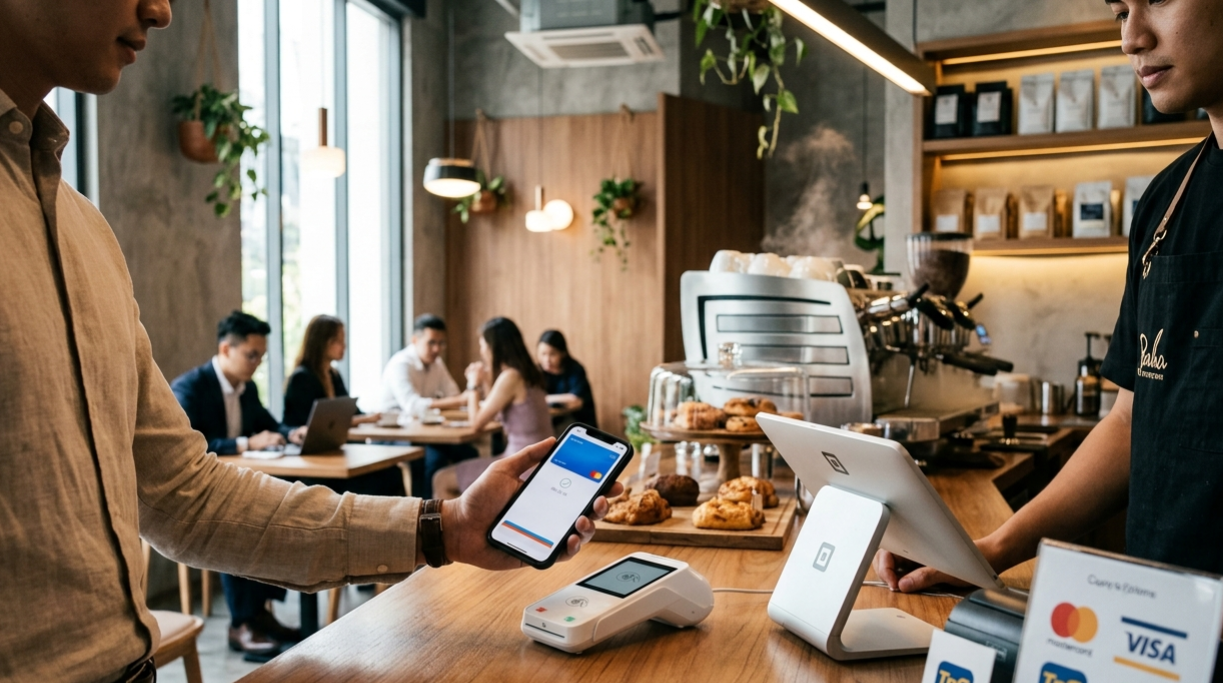
Every time a customer pays by card or e-wallet at your restaurant, a small slice of that sale quietly disappears before it reaches your account. Most business owners know payment gateway fees exist — but very few have actually sat down and calculated how much they add up to over a month, a quarter, or a year. This post does that calculation for you, with real numbers for the Malaysian market.
The Silent Cost of Accepting Digital Payments
Payment gateway fees in Malaysia typically take the form of a Merchant Discount Rate (MDR) — a percentage of every transaction that goes to the payment provider. On a single RM50 meal, it feels like nothing. Across hundreds of transactions a day, it's a different story.
Typical MDR range for card payments in Malaysia
Lost per month on RM100k revenue at a 3% MDR
Annual drain — enough to hire a part-time staff member
Those numbers assume a business doing RM100,000 in monthly revenue — not unusual for a mid-sized café or casual dining outlet. At 3%, that's RM36,000 a year going straight to the payment provider. Not to your kitchen. Not to your team. Gone.
What Actually Makes Up a Payment Gateway Fee?
The percentage you pay isn't always a single flat rate. Several components can stack together depending on your provider and payment method:
Merchant Discount Rate (MDR)
The base percentage charged per transaction. Varies by card type — domestic Visa/Mastercard typically runs lower than international cards.
Setup & Monthly Fees
Some providers charge a one-time onboarding fee and a recurring monthly platform fee on top of the MDR — even if you process zero transactions that month.
Refund & Chargeback Fees
Processing a refund often still costs you the original transaction fee, and a chargeback dispute can trigger a separate penalty fee of RM50–RM100 or more per case.
Settlement Delays
Not a fee in name, but a hidden cost. Many gateways hold funds for 2–7 business days before settling to your bank — a real cash-flow problem for F&B businesses that pay suppliers weekly.
Payment Gateway Fees in Malaysia: Provider Comparison
Here's how the major payment gateways and e-wallet processors in Malaysia compare for a typical F&B merchant. Rates shown are standard published rates — negotiated rates may differ for high-volume merchants.
| Provider | Payment Type | MDR / Fee | Settlement |
|---|---|---|---|
| Billplz | FPX (Online Banking) | RM1–RM3 flatPer transaction, capped | 1–2 days |
| iPay88 | Credit / Debit Card | 2.0–2.5%+ setup & monthly fees | 3–5 days |
| Stripe | Credit / Debit Card | 3.0% + 30¢No monthly fee | 7 days (MY) |
| Toyyibpay | FPX / Card | 1.0–1.5%Lower for FPX | 1–3 days |
| GrabPay | E-wallet | ~1.5%Varies by campaign | 1–2 days |
| Touch 'n Go eWallet | E-wallet / DuitNow QR | 0.5–1.0%DuitNow QR rate | 1 day |
| ShopeePay | E-wallet | ~1.5%Standard merchant rate | 1–3 days |
| Boost | E-wallet | 0.5–1.0%Competitive for F&B | 1–2 days |
* Rates are indicative and subject to change. Always verify directly with the provider before committing.
Calculate Your Monthly Fee Drain
Plug in your numbers to see exactly how much you're paying in gateway fees each month — and how much you'd save by shifting more customers to lower-cost payment methods.
💸 Fee Drain Calculator
Why QR-Based Ordering Changes the Equation
The most effective way to reduce payment gateway fees isn't to negotiate harder with your bank — it's to shift the payment method mix. QR-based ordering systems, particularly those that route through DuitNow QR, carry some of the lowest MDRs available in Malaysia today.
When a customer scans a table QR code and pays directly through their banking app or TnG eWallet via DuitNow, the merchant rate can be as low as 0.5% — compared to 2.5–3% for a credit card swipe. On that same RM100,000 monthly revenue, you're looking at RM500 in fees versus RM3,000. Same sales volume. Five times lower cost.
Three Ways to Reduce Your Gateway Fee Exposure
Shift customers toward DuitNow QR & FPX
These payment rails carry the lowest MDR in Malaysia. Table QR codes naturally nudge customers in this direction without you having to say a word — they scan, choose their bank app, and pay.
Audit your current payment mix monthly
Most POS dashboards break down sales by payment method. If 60%+ of your revenue is running through card, you're paying a premium unnecessarily. Understanding your mix is the first step to reducing it.
Negotiate your MDR if volume justifies it
Merchants processing above RM50,000–RM100,000 per month often have room to negotiate lower rates with their payment provider. Most don't realise this is possible. Ask — the worst answer is no.
Common Questions About Payment Gateway Fees in Malaysia
The Bottom Line
Payment gateway fees in Malaysia aren't a fixed cost of doing business — they're a variable you can actively manage. The mix of payment methods your customers use directly determines how much you hand over to the gateway each month. QR-based ordering systems shift that mix toward lower-cost rails, automatically and without friction.
For a restaurant doing RM50,000 a month, even moving 30% of card transactions to DuitNow QR can save RM500–800 monthly. That's staff wages, ingredient upgrades, or simply better margin on every plate you serve.
Stop paying 3% on every card swipe
RovaSolution's QR ordering system routes payments through Malaysia's lowest-MDR channels by default. See how much you could save.
Talk to the Team